What Was a Piece of Art That Was Similar to Nerfitit
| Nefertiti Bust | |
|---|---|
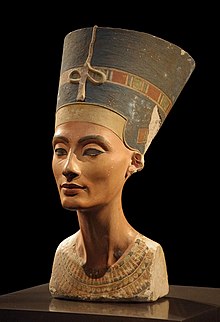 The iconic bust of Nefertiti is part of the Egyptian Museum of Berlin collection. | |
| Cloth | Limestone and stucco |
| Height | 48 centimetres (19 in) |
| Weight | 20 kilograms (44 lb) |
| Created | 1345 BCE Thutmose, Aboriginal Egypt |
| Discovered | 6 Dec 1912 Amarna, Egypt |
| Discovered past | German Oriental Gild |
| Nowadays location | Neues Museum Berlin, Deutschland |
| Identification | ÄM 21300 |
The Nefertiti Bust is a painted stucco-coated limestone bust of Nefertiti, the Great Purple Wife of Egyptian pharaoh Akhenaten.[ane] The work is believed to take been crafted in 1345 BCE by Thutmose considering it was constitute in his workshop in Amarna, Egypt.[two] It is one of the virtually-copied works of ancient Egypt. Nefertiti has become one of the most famous women of the ancient world and an icon of feminine beauty.
A German archaeological team led past Ludwig Borchardt discovered the bust in 1912 in Thutmose'southward workshop.[3] Information technology has been kept at various locations in Germany since its discovery, including the cellar of a bank, a salt-mine in Merkers-Kieselbach, the Dahlem museum, the Egyptian Museum in Charlottenburg and the Altes Museum.[3] It is currently on display at the Neues Museum in Berlin, where it was originally displayed before Globe War II.[3]
The Nefertiti bosom has go a cultural symbol of Berlin too equally ancient Egypt. It has too been the discipline of an intense argument between Egypt and Germany over Egyptian demands for its repatriation, which began in 1924, in one case the bust was first displayed to the public. Egyptian inspectors said their predecessors were misled about the actual bust earlier they let it out of the country, and the Berlin museum refers to an official protocol, signed by the High german excavator and the Egyptian Antiquities Service of the time, nigh "a painted plaster bust of a princess".
History [edit]
Background [edit]

A "house altar" (c. 1350 BCE) depicting Akhenaten, Nefertiti and three of their daughters. Nefertiti is shown wearing a crown similar to that depicted on the bust.
Nefertiti (meaning "the beautiful 1 has come forth") was the 14th-century BCE Great Royal Wife (master consort) of the Egyptian Pharaoh Akhenaten of the Eighteenth Dynasty of Arab republic of egypt. Akhenaten initiated a new monotheistic class of worship called Atenism dedicated to the Sun disc Aten.[4] Piffling is known about Nefertiti. Theories suggest she could take been an Egyptian royal by nativity, a foreign princess or the daughter of a loftier government official named Ay, who became pharaoh afterwards Tutankhamun. She may have been the co-regent of Arab republic of egypt with Akhenaten, who ruled from 1352 BCE to 1336 BCE.[4] Nefertiti bore half dozen daughters to Akhenaten, i of whom, Ankhesenpaaten (renamed Ankhesenamun after the suppression of the Aten cult), married Tutankhamun, Nefertiti's stepson. While information technology was once thought that Nefertiti disappeared in the twelfth twelvemonth of Akhenaten's reign because of her death or because she took a new name, she was still live in the sixteenth twelvemonth of her husband'due south reign according to a limestone quarry inscription found at Dayr Abū Ḥinnis[five] "on the eastern side of the Nile, about 10 kilometres north of Amarna."[half dozen] Nefertiti may have go a pharaoh in her own right for a curt time later on her husband'due south decease.[4] [7]
The bust of Nefertiti is believed to have been crafted near 1345 BCE by the sculptor Thutmose.[four] [8] The bust does non accept any inscriptions, simply tin can be certainly identified every bit Nefertiti by the characteristic crown, which she wears in other surviving (and clearly labelled) depictions, for case the "house altar".[9]
Discovery [edit]

The bust was constitute on six December 1912 at Amarna past the German Oriental Visitor (Deutsche Orient-Gesellschaft – Canis familiaris), led by High german archaeologist Ludwig Borchardt. It was found in what had been the workshop of the sculptor Thutmose, along with other unfinished busts of Nefertiti.[ten] [xi] Borchardt's diary provides the chief written account of the find; he remarks, "Suddenly we had in our easily the most live Egyptian artwork. Y'all cannot draw it with words. You must encounter information technology."[12]
A 1924 document found in the athenaeum of the German Oriental Company recalls a 20 January 1913 meeting betwixt Borchardt and a senior Egyptian official to discuss the division of the archeological finds of 1912 between Deutschland and Egypt. According to the secretary of the German Oriental Company (who was the author of the document and who was present at the meeting), Borchardt "wanted to salve the bust for us".[13] [14] Borchardt is suspected of having concealed the bosom's real value,[fifteen] although he denied doing so.[16]
While Philipp Vandenberg describes the coup as "adventurous and beyond comparing",[17] Time magazine lists it among the "Top ten Plundered Artifacts".[xviii] Borchardt showed the Egyptian official a photograph of the bust "that didn't prove Nefertiti in her all-time low-cal". The bust was wrapped up in a box when Egypt'due south chief antiques inspector, Gustave Lefebvre, came for inspection. The document reveals that Borchardt claimed the bust was fabricated of gypsum to mislead Lefebvre. The German language Oriental Company blames the negligence of Lefebvre and points out that the bosom was at the top of the exchange list and says the bargain was done fairly.[fourteen] [19]
Description and examinations [edit]

3D model, click to interact.
The bust is 48 centimetres (19 in) tall and weighs almost xx kilograms (44 lb). It is made of a limestone core covered with painted stucco layers. The face is completely symmetrical and almost intact, but the left heart lacks the inlay present in the correct.[twenty] [21] The pupil of the right eye is of inserted quartz with black paint and is fixed with beeswax. The background of the centre-socket is unadorned limestone. Nefertiti wears her characteristic bluish crown known equally the "Nefertiti cap crown" with a golden diadem band looped around like horizontal ribbons and joining at the back, and an Uraeus (cobra), which is now broken, over her brow. She also wears a wide collar with a floral design.[22] The ears accept suffered some impairment.[21] Gardner's Art Through the Ages suggests that "With this elegant bust, Thutmose may have been alluding to a heavy flower on its slender sleek stalk by exaggerating the weight of the crowned head and the length of the almost serpentine neck."[23]
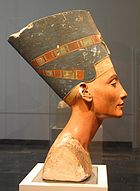


Co-ordinate to David Silverman, the bust reflects the classical Egyptian art fashion, diffusive from the "eccentricities" of the Amarna art way, which was developed in Akhenaten'southward reign. The verbal function of the bust is unknown, though it is theorized that the bust may exist a sculptor'due south modello to be used as a ground for other official portraits, kept in the artist'due south workshop.[24]
Colours [edit]
Borchardt commissioned a chemical analysis of the coloured pigments of the head. The outcome of the examination was published in the book Portrait of Queen Nofretete in 1923:[25]
- Blueish: powdered frit, coloured with copper oxide
- Pare colour (light blood-red): fine powdered lime spar colored with red chalk (iron oxide)
- Yellow: orpiment (arsenic sulfide)
- Green: powdered frit, coloured with copper and iron oxide
- Blackness: coal with wax as a bounden medium
- White: chalk
Missing left eye [edit]
When the bust was start discovered, no quartz to represent the iris of the left eyeball was present as in the other eye, and none was plant despite an intensive search and a then pregnant advantage of £one thousand being put up for information regarding its whereabouts.[26] Borchardt assumed that the quartz iris had fallen out when Thutmose's workshop fell into ruin.[27] The missing centre led to speculation that Nefertiti may have suffered from an ophthalmic infection and lost her left eye, though the presence of an iris in other statues of her contradicted this possibility.[28]
Dietrich Wildung proposed that the bust in Berlin was a model for official portraits and was used by the main sculptor for teaching his pupils how to cleave the internal structure of the eye, and thus the left iris was not added.[29] Gardner'southward Fine art Through the Ages and Silverman present a similar view that the bust was deliberately kept unfinished.[21] [23] Zahi Hawass, former Egyptian Minister of Land for Antiquities Affairs, suggested that Thutmose created the left eye, but that it was later destroyed.[30]
CT scans [edit]
The bosom was get-go CT scanned in 1992, with the scan producing cross sections of the bust every five millimetres (0.20 in).[31] [32] In 2006, Dietrich Wildung, director of Berlin's Egyptian Museum, while trying a different lighting at the Altes Museum, where the bosom was so displayed, observed wrinkles on Nefertiti'southward cervix and bags under her eyes, suggesting the sculptor had tried to depict signs of crumbling. A CT scan confirmed Wildung'due south findings; Thutmose had added gypsum under the cheeks and eyes in an effort to perfect his sculpture.[29]
The CT browse in 2006, led past Alexander Huppertz, director of the Imaging Science Found in Berlin, revealed a wrinkled face of Nefertiti carved in the inner core of the bosom.[32] The results were published in the April 2009's Radiology.[33] The scan revealed that Thutmose placed layers of varying thickness on top of the limestone core. The inner face has creases effectually her mouth and cheeks and a swelling on the nose. The creases and the bump on the nose are leveled by the outermost stucco layer. According to Huppertz, this may reverberate "aesthetic ideals of the era".[8] [34] The 2006 scan provided greater detail than the 1992 one, revealing subtle details simply ane–ii millimetres (0.039–0.079 in) under the stucco.[31]
Later on history [edit]
The bosom has become "one of the nearly admired, and well-nigh copied, images from ancient Egypt", and the star exhibit used to market Berlin's museums.[35] Information technology is seen as an "icon of international beauty."[15] [29] [36] "Showing a woman with a long neck, elegantly arched brows, loftier cheekbones, a slender nose and an enigmatic smile played about cherry-red lips, the bust has established Nefertiti as ane of the nearly beautiful faces of antiquity."[29] Information technology is described equally the most famous bust of ancient fine art, comparable but to the mask of Tutankhamun.[22]
Nefertiti has become an icon of Berlin's culture.[x] Some 500,000 visitors encounter her every year.[xiv] The bust is described equally "the best-known piece of work of art from ancient Arab republic of egypt, arguably from all artifact".[37] Her face is on postcards of Berlin and 1989 German postage stamps.[36] [38]
Locations in Deutschland [edit]

Neues Museum, Berlin is the nowadays location of the Nefertiti bosom
The bust has been in Deutschland since 1913,[13] when information technology was shipped to Berlin and presented to James Simon, a wholesale merchant and the sponsor of the Amarna earthworks.[eleven] Information technology was displayed at Simon's residence until 1913, when Simon lent the bust and other artifacts from the Amarna dig to the Berlin Museum.[39] Although the rest of the Amarna collection was displayed in 1913–xiv, the bust was kept secret at Borchardt's request.[17] In 1918, the museum discussed the public brandish of the bosom, only again kept information technology hush-hush at the request of Borchardt.[39] It was permanently donated to the museum in 1920. In 1923, the bust was revealed to the public in Borchardt's writings; in 1924, it was displayed to the public as part of the Egyptian Museum of Berlin.[17] [39] The bust created a sensation, swiftly condign a world-renowned icon of feminine beauty and one of the most universally recognised artifacts to survive from Ancient Egypt. The bust was displayed in Berlin'south Neues Museum on Museum Island until the museum was closed in 1939; with the onset of World War 2, Berlin museums were emptied and artifacts moved to secure shelters for safekeeping.[xi] Initially stored in the cellar of the Prussian Governmental Bank, the bust was moved in the fall of 1941 to the belfry of a flak bunker in Berlin.[39] The Neues Museum suffered bombings in 1943 by the Imperial Air Strength.[40] On 6 March 1945, the bust was moved to a High german table salt mine at Merkers-Kieselbach in Thuringia.[11]
In March 1945, the bust was found by the American Army and given over to its Monuments, Fine Arts and Athenaeum co-operative. It was moved to the Reichsbank in Frankfurt and shipped in August to the U.S. Primal Collecting Bespeak in Wiesbaden, where it was put on public display beginning in 1946.[11] [39] Information technology remained on brandish at the Museum Wiesbaden for ten years before being transferred in 1956 to West Berlin,[11] where it was exhibited at the Dahlem Museum. Equally early as 1946, East Federal republic of germany (German Autonomous Republic) pressed for the return of the bust to Museum Island in E Berlin, where it had been displayed before the war.[xi] [39] In 1967, the bust was moved to the Egyptian Museum in the Charlottenburg borough of Berlin and remained at that place until 2005, when it was moved to the Altes Museum.[39] The bust returned to the Neues Museum as its centerpiece when the museum reopened in October 2009.[fifteen] [40] [41]
Controversies [edit]
| External video | |
|---|---|
 | |
 Thutmose'southward Bust of Nefertiti (Amarna Period), Smarthistory[42] Thutmose'southward Bust of Nefertiti (Amarna Period), Smarthistory[42] |
Requests for repatriation to Arab republic of egypt [edit]
Since the official unveiling of the bust in Berlin in 1924, Egyptian authorities have demanded its render to Egypt.[x] [39] [43] In 1925, Egypt threatened to ban German excavations in Egypt unless the bosom was returned. In 1929, Egypt offered to substitution other artifacts for the bosom, but Deutschland declined.
Although Deutschland had previously strongly opposed repatriation, in 1933 Hermann Göring considered returning the bust to King Farouk Fouad of Egypt as a political gesture. Hitler opposed the idea and told the Egyptian government that he would build a new Egyptian museum for Nefertiti. "In the centre, this wonder, Nefertiti, will be enthroned," Hitler said. "I will never relinquish the caput of the Queen."[fifteen] [43] While the bust was under American control, Arab republic of egypt requested the United States to hand information technology over; the U.s. refused and brash Egypt to have up the matter with the new German authorities.[39] In the 1950s, Egypt again tried to initiate negotiations, but there was no response from Germany.[39] [43] In 1989, Egyptian President Hosni Mubarak viewed the bosom and announced that Nefertiti was "the all-time administrator for Egypt" in Berlin.[39]
Egyptian archaeologist, Egyptologist, and sometime Minister of State for Antiquities Affairs, Zahi Hawass believed that the bust belongs to Egypt and that it was taken out of Egypt illegally and should therefore be returned. He maintained the stance that Egyptian regime were misled over the acquisition of the bust in 1913 and demanded that Germany bear witness that it was exported legally.[13] [44] According to Kurt G. Siehr, another statement in support of repatriation is that "Archeological finds have their 'home' in the country of origin and should exist preserved in that country."[45] The repatriation issue sprang up once more in 2003 over the Body of Nefertiti sculpture. In 2005, Hawass requested that UNESCO intervene to return the bust.[46]
In 2007, Hawass threatened to ban exhibitions of Egyptian artifacts in Deutschland, if the bust was not lent to Egypt, but to no avail. He likewise requested a worldwide boycott of loans to German museums to initiate what he called a "scientific state of war". Hawass wanted Frg to lend the bosom to Arab republic of egypt in 2012 for the opening of the new K Egyptian Museum about the Smashing Pyramids of Giza.[35] Simultaneously, a campaign chosen "Nefertiti Travels" was launched by cultural association CulturCooperation, based in Hamburg, Frg. They distributed postcards depicting the bust with the words "Render to Sender" and wrote an open up letter to German Culture Minister Bernd Neumann supporting the view that Egypt should be given the bust on loan.[36] [47] In 2009, when the bosom was moved back to the Neues Museum, the ceremoniousness of Berlin every bit its location was questioned.
Several German art experts have attempted to refute all the claims made by Hawass, pointing to the 1924 document discussing the pact betwixt Borchardt and Egyptian government.[thirteen] [14] High german government take also argued the bosom is as well delicate to ship and that legal arguments for repatriation were insubstantial. According to The Times, Germany may be concerned that lending the bust to Egypt would mean its permanent difference from Frg.[xv] [35]
In December 2009, Friederike Seyfried, managing director of Berlin's Egyptian Museum and Papyrus Collection, presented to the Egyptians documents held by the museum regarding the discovery of the bust, which include a protocol signed by the German language excavator and the Egyptian Antiquities Service. In the documents, the bust was listed as a painted plaster bust of a princess, simply in his diary, Borchardt clearly referred to it as the caput of Nefertiti. "This proves that Borchardt wrote this clarification so that his land can become the statue," Hawass said. "These materials ostend Egypt's contention that (he) did human activity unethically with intent to deceive." However, Hawass said Egypt didn't consider the bust to be a looted antiquity. "I actually want it back," he said.[35] His argument also said that the authority to approve the return of the bust to Arab republic of egypt lies with the Prussian Cultural Heritage Foundation and the High german culture government minister.[48]
Allegations over authenticity [edit]
The French language book Le Buste de Nefertiti – une Imposture de l'Egyptologie? (The Bust of Nefertiti – a Fraud in Egyptology?) past Swiss art historian Henri Stierlin and the book Missing Link in Archaeology past Berlin author and historian Erdogan Ercivan both claimed that the bust was a modern faux. Stierlin claims that Borchardt may take created the bust to exam ancient pigments and that when the bust was admired past Prince Johann Georg of Saxony, Borchardt pretended it was genuine to avoid offending the prince. Stierlin argues that the missing left eye of the bosom would take been a sign of disrespect in ancient Egypt, that no scientific records of the bust appear until 11 years subsequently its supposed discovery and, while the paint pigments are ancient, the inner limestone core has never been dated. Ercivan suggests Borchardt's wife was the model for the bust and both authors argue that it was not revealed to the public until 1924 because information technology was a fake.[12] Another theory suggested that the existing bust was crafted in the 1930s on Hitler'southward orders and that the original was lost in Earth War Ii.[19]

In 1989, a 70 pfennig postage stamp which featured the bust of Nefertiti was on issue in (West) Germany.
Dietrich Wildung dismissed the claims equally a publicity stunt since radiological tests, detailed computer tomography and material assay have proved its actuality.[12] The pigments used on the bosom have been matched to those used past aboriginal Egyptian artisans. The 2006 CT scan that discovered the "hidden face" of Nefertiti proved, according to Science News, that the bust was genuine.[19]
Egyptian authorities besides dismissed Stierlin's theory. Hawass said, "Stierlin is non a historian. He is delirious." Although Stierlin had argued "Egyptians cut shoulders horizontally" and Nefertiti had vertical shoulders, Hawass said that the new manner seen in the bosom is part of the changes introduced by Akhenaten, the husband of Nefertiti. Hawass too claimed that Thutmose had created the eye, simply it was after destroyed.[30]
Body of Nefertiti [edit]
In 2003, the Egyptian Museum in Berlin allowed the Hungarian artist duo Little Warsaw, András Gálik and Bálint Havas, to place the bust atop a nearly nude female statuary for a video installation to exist shown at the Venice Biennale modern fine art festival. The artists said the project, called Body of Nefertiti, was an endeavor to pay homage to the bust. Co-ordinate to Wildung, it showed "the continued relevance of the ancient world to today's fine art."[49] Egyptian cultural officials proclaimed it to exist a disgrace to "ane of the great symbols of their country's history" and banned Wildung and his married woman from farther exploration in Egypt.[35] [49] [l] The Egyptian Government minister for Culture, Farouk Hosny, declared that Nefertiti was "non in safe hands" and although Egypt had not renewed their claims for restitution "due to the good relations with Germany," this "recent behaviour" was unacceptable.[39]
3D scan of the Bust [edit]
In 2016 a liberty of information request was made to the Egyptian Museum for access to a total color scan of the bust that had been made by the museum 10 years prior. The museum declined the request citing touch on on gift shop revenue. Somewhen the Prussian Cultural Heritage Foundation which oversees the museum released the file, which is now available[51] (not directly from the museum), yet controversially attached a copyright to the work, which is in the public domain.[52]
Cultural significance [edit]
In 1930, the German language printing described the bust as their new monarch, personifying it equally a queen. As the "'most precious ... stone in the setting of the diadem' from the art treasures of 'Prussia Deutschland'", Nefertiti would re-found the imperial German national identity after 1918.[53] Hitler described the bust every bit "a unique masterpiece, an ornament, a true treasure", and pledged to build a museum to business firm it.[12] Past the 1970s, the bust had become an upshot of national identity to both German states, East Germany and W Germany, created subsequently World State of war Ii.[53] In 1999, the bust appeared on an election poster for the green political party Bündnis 90/Dice Grünen as a promise for a cosmopolitan and multi-cultural surroundings with the slogan "Stiff Women for Berlin!"[38] According to Claudia Breger, another reason that the bust became associated with German language national identity was its place as a rival to Tutankhamun, plant by the British who then ruled Arab republic of egypt.[38]
The bust became an influence on pop culture, with Jack Pierce's make-upward piece of work on Elsa Lanchester's hairstyle in the film Helpmate of Frankenstein being inspired past information technology.[54]
References [edit]
- Notes
- ^ "Nefertiti – Aboriginal History". History.com . Retrieved 18 Nov 2016.
- ^ e.V., Verein zur Förderung des Ägyptischen Museums und Papyrussammlung Berlin. "Nefertiti: (Society for the Promotion of the Egyptian Museum Berlin)". world wide web.egyptian-museum-berlin.com . Retrieved 18 November 2016.
- ^ a b c Tharoor, Ishaan. "The Bust of Nefertiti: Remembering Ancient Egypt'southward Famous Queen". Time. ISSN 0040-781X. Retrieved 18 November 2016.
- ^ a b c d Maryalice Yakutchik. "Who Was Nefertiti?". Discovery Channel. Archived from the original on v January 2010. Retrieved 23 Nov 2009.
- ^ Athena van der Perre, The Year 16 graffito of Akhenaten in Dayr Abū Ḥinnis. A Contribution to the Study of the Later Years of Nefertiti, Journal of Egyptian History (JEH) 7 (2014), pp. 67–108
- ^ A. Van der Perre, 'Nefertiti's last documented reference for now' F. Seyfried (ed.), In the Light of Amarna. 100 Years of the Nefertiti Discovery, (Berlin, 2012), pp. 195–97 (academia.edu)
- ^ Silverman, Wegner, Wegner pp. 130–33
- ^ a b Christine Dell'Amore (30 March 2009). "Nefertiti'southward Existent, Wrinkled Confront Constitute in Famous Bust?". National Geographic Society. Retrieved 16 Nov 2009.
- ^ Charlotte Booth (2007). The Aboriginal Egyptians for Dummies. for Dummies. ISBN978-0-470-06544-0.
- ^ a b c Breger p. 285
- ^ a b c d e f g Siehr p. 115
- ^ a b c d Connolly, Kate (seven May 2009). "Is this Nefertiti – or a 100-year-old fake?". The Guardian. London. Retrieved 21 November 2009.
- ^ a b c d Dempsy, Judy (eighteen October 2009). "A 3,500-Year-Old Queen Causes a Rift Betwixt Federal republic of germany and Egypt". The New York Times . Retrieved 15 Nov 2009.
- ^ a b c d "Archaeological Controversy: Did Germany Crook to Get Bust of Nefertiti?". Spiegel Online. 10 February 2009. Retrieved 17 November 2009.
- ^ a b c d e Roger Boyes (xx October 2009). "Neues Museum refuses to return the bust of Queen Nefertiti to Egyptian museum". The Times. London. Retrieved 15 November 2009.
- ^ Berger p. 288
- ^ a b c Breger p. 286
- ^ "Top x Plundered Artifacts". Time. five March 2009. Archived from the original on 1 March 2020. Retrieved 24 Nov 2009.
- ^ a b c "Nefertiti'southward 'subconscious confront' proves Berlin bust is not Hitler's fake". Science News. 27 April 2009. Archived from the original on 4 July 2012. Retrieved 23 November 2009. For pictures, "Nefertiti's 'Hidden Confront' Proves Famous Berlin Bosom is not Hitler's Fake". three April 2009. Retrieved 23 November 2009.
- ^ Horst Woldemar Janson; Anthony F. Janson (2003). History of art: the Western tradition. Prentice Hall PTR. ISBN978-0-13-182895-7.
- ^ a b c Silverman, Wegner, Wegner pp. 21, 113
- ^ a b Schultz. Egypt the World of Pharaohs: The Earth of the Pharaohs. American Univ in Cairo Printing. p. 203. ISBN978-977-424-661-6.
- ^ a b Helen Gardner (2006). "Fine art of Ancient Egypt". Gardner's Art Through the Ages: the western perspective. Cengage Learning. p. 64. ISBN978-0-495-00478-3.
- ^ Silverman, David P. (1997). Ancient Arab republic of egypt. The states: Oxford University Printing. p. 221. ISBN0-19-521952-X.
- ^ Rudolph Anthes (1961). Nofretete – The Head of Queen Nofretete. Mann, Berlin: Verlag Gebr. p. six.
- ^ Matthias Schulz (2012). "Die entführte Königin (German)". Der Spiegel (3 December 2012): 128.
- ^ Joyce A. Tyldesley, Nefertiti: Egypt's sunday queen, Viking, 1999, p.196.
- ^ Fred Gladstone Bratton, A history of Egyptian archaeology, Unhurt, 1968, p.223
- ^ a b c d Lorenzi, R (v September 2006). "Scholar: Nefertiti Was an Aging Beauty". Discovery News. Discovery Channel. pp. i–2. Retrieved 18 December 2009.
- ^ a b Szabo, Christopher (12 May 2009). "Arab republic of egypt's Rubbishes Claims that Nefertiti Bust is 'Fake'". DigitalJournal.com.
- ^ a b Patrick McGroarty (31 March 2009). "Nefertiti Bosom Has Ii Faces". Discovery News. Discovery Channel. pp. one–2. Retrieved 17 Nov 2009.
- ^ a b For comparative analysis between 1992 and 2006 CT scans: Bernhard Illerhaus; Andreas Staude; Dietmar Meinel (2009). "Nondestructive Insights into Composition of the Sculpture of Egyptian Queen Nefertiti with CT and the dependence of object surface from image processing" (PDF). NDT Database & e-Journal of Nondestructive Testing.
- ^ Alexander Huppertz, A; Dietrich Wildung; Barry J. Kemp; Tanja Nentwig; Patrick Asbach; Franz Maximilian Rosche; Bernd Hamm (April 2009). "Nondestructive Insights into Composition of the Sculpture of Egyptian Queen Nefertiti with CT". Radiology. Radiological Guild of N America. 251 (1): 233–240. doi:10.1148/radiol.2511081175. PMID 19332855.
- ^ "Hidden Face In Nefertiti Bust Examined With CT Scan". Science Daily. eight Apr 2009. Retrieved 23 November 2009.
- ^ a b c d east Dan Morrison (18 April 2007). "Egypt Vows "Scientific State of war" If Federal republic of germany Doesn't Loan Nefertiti". National Geographic News. National Geographic Society. Retrieved 15 November 2009.
- ^ a b c Moore, Tristana (7 May 2007). "Row over Nefertiti bust continues". BBC News . Retrieved 22 November 2009.
- ^ Siehr p.114
- ^ a b c Breger p. 292
- ^ a b c d e f g h i j k l "The Bust of Nefertiti: A Chronology". "Nefertiti travels" campaign website. CulturCooperation. 2007. Archived from the original on 18 March 2015. Retrieved 22 Nov 2009.
- ^ a b Tony Paterson (17 October 2009). "Queen Nefertiti rules again in Berlin's reborn museum". The Independent. London. Retrieved 15 November 2009.
- ^ Isabelle de Pommereau (ii November 2009). "Federal republic of germany: Time for Egypt'due south Nefertiti bosom to get abode?". The Christian Science Monitor . Retrieved 15 November 2009.
- ^ "Thutmose'due south Bust of Nefertiti (Amarna Menstruation)". Smarthistory at Khan Academy. Retrieved 15 March 2013.
- ^ a b c Sieher p. 116
- ^ Kimmelman, Michael (23 October 2009). "When Aboriginal Artifacts Become Political Pawns". New York Times . Retrieved xv November 2009.
- ^ Siehr pp. 133–4
- ^ El-Aref, Nevine (14–20 July 2005). "Antiquities wish list". Al-Ahram Weekly (751). Archived from the original on xvi September 2010.
- ^ "Nefertiti travels". CulturCooperation. 2007. Archived from the original on eighteen May 2015. Retrieved 22 November 2009.
- ^ The Associated Printing:Egypt antiquities principal to demand Nefertiti bust
- ^ a b HUGH EAKIN (21 June 2003). "Nefertiti'due south Bosom Gets a Body, Offending Egyptians". The New York Times . Retrieved 21 November 2009.
- ^ For a motion-picture show of "The Trunk of Nefertiti" meet "Nefertiti's Bust Gets a Body, Offending Egyptians: A Problematic Juxtaposition". The New York Times. 21 June 2003. Archived from the original on 8 October 2011. Retrieved 23 November 2009.
- ^ https://www.thingiverse.com/thing:3974391
- ^ https://reason.com/2019/11/13/a-german-museum-tried-to-hibernate-this-stunning-3d-scan-of-an-iconic-egyptian-artifact-today-you-can-encounter-it-for-the-first-time/
- ^ a b Breger p. 291
- ^ Elizabeth Young, "Here Comes the Helpmate: Wedding ceremony Gender and Race in Bride of Frankenstein"; Feminist Studies, Vol. 17, 1991. 35 pgs.
- Books
- Anthes, Rudolph (1961). Nofretete – The Head of Queen Nofretete. Gebr. Mann.
- Breger, Claudia (2006). "The 'Berlin' Nefertiti Bust". In Regina Schulte (ed.). The Body of the Queen: Gender and Rule in the Courtly World, 1500–2000. Berghahn Book. ISBN1-84545-159-7.
- Siehr, Kurt Grand (August 2006). "The Beautiful One has come up – to Return". In John Henry Merryman (ed.). Imperialism, Art and Restitution. Cambridge Academy Press. ISBN0-521-85929-8.
- Silverman, David P.; Wegner, Josef William; Wegner, Jennifer Houser (2006). Akhenaten and Tutankhamun: Revolution and Restoration. University of Pennsylvania, Museum of Archaeology. ISBN978-one-931707-ninety-9.
- Tyldesley, Joyce (2018). Nefertiti's Face: The Cosmos of an Icon. Harvard University Press. ISBN978-0-674-98375-five.
External links [edit]
- Neues Museum Berlin
- 3D scan of the bust by TrigonArt
Source: https://en.wikipedia.org/wiki/Nefertiti_Bust
0 Response to "What Was a Piece of Art That Was Similar to Nerfitit"
Post a Comment